
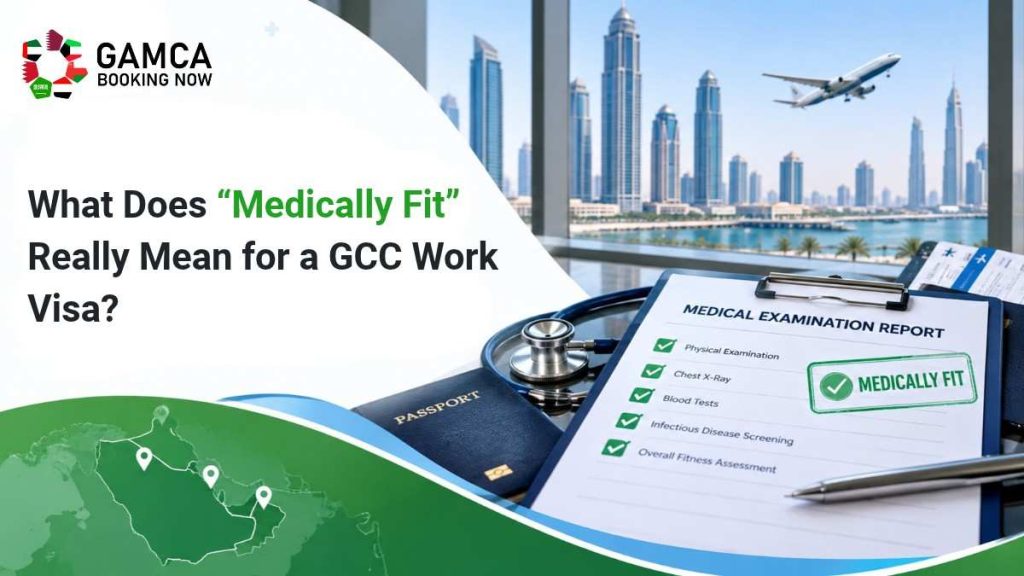
You have a job offer in the Gulf, and your recruiter says the next step is the GAMCA medical. Nobody explains what “fit” actually measures, who decides it, or what happens if the result is something else. That gap is where most of the worry, and most of the avoidable mistakes, come from.
This guide is for applicants and the recruiters who place them. It explains what a fit result is and is not, how the GAMCA medical and the GCC medical appointment process fit together, what an unfit or pending result means, and how to book the first time properly.
The Short Answer
Medically fit means an accredited GAMCA (now Wafid) medical centre found nothing that the Gulf Health Council’s rules list as disqualifying for your visa. It is a screening result, not a full health check, and not visa approval. The centre issues the result; the destination country makes the visa decision.
What "Medically Fit" Actually Means
A GCC medical is a screening, not a check-up. The Gulf Health Council, which runs the program, describes its aim as making sure that expatriates coming for work or residence are free from infectious diseases that could spread in Gulf communities. It does not assess how healthy you are in general, and it does not predict how well you will do the job.
“Fit” therefore means one narrow thing: on the day of your examination, the centre’s findings did not trigger any condition on the official list. Three things follow from that.
- A fit result is not a visa. Final approval stays with the destination country and its authorities.
- The centre decides the result. Booking services, recruiters, and employers do not.
- The certificate expires. Our status guide notes that a GCC fitness certificate is generally valid for two months, although the rules can vary by country and visa category.
When you are ready to start, you can book your GAMCA medical appointment online and receive your slip with the assigned centre.
GAMCA, Wafid And The "GCC medical": The Same Thing?
In everyday use, yes. GAMCA was the long-standing name for the medical examination system, and the official program is now called Wafid, run by the Gulf Health Council. Your slip may say Wafid, your recruiter may say GAMCA and your visa form may say GCC medical. They refer to the same required examination.
The program is large. Reporting by the migrant rights group MRRORS puts it at more than 880 accredited centres in 30 countries. It also notes that the Gulf Health Council revised the program’s regulations in 2026, and that Kuwait’s health ministry published a resolution to apply them on 17 May 2026. Read that as a sign the rules are moving, so check current requirements before you book.
What The Examination Involves
The screening includes a physical examination, blood and urine tests, and a chest X-ray. Exact tests can depend on your destination and visa category, so confirm details with the centre when you receive your slip.
Results then appear in one of four ways:
Status | What it means | What to do next |
|---|---|---|
Fit | The centre recorded you as meeting the requirements | Save a copy of the report and share it with your employer or agent |
Unfit | The centre found a condition that does not meet the requirements | Ask the centre to explain, see a doctor, and ask about options |
Pending or hold | Results are still under review, or more evaluation is needed | Wait for the expected processing time, then contact the centre |
Absent | You did not attend or complete your slot | Contact the centre or support about your options |
What Can Make a Result Unfit
The official rules list the conditions that make a result unfit. Infectious or contagious diseases such as HIV, hepatitis B and hepatitis C, and tuberculosis are among the list. The Gulf Health Council’s own rules are the authority, and a doctor is the right person to discuss your health.
A few points are worth knowing because they confuse:
- Workers are sometimes classed as unfit after scarring from past, fully treated tuberculosis. If you have a medical history like that, bring your records and ask the centre how it will be handled.
- The revised regulations establish a Grievance Committee to review complaints and appeals, including those from migrants.
- Moreover, applicants issued an unfit certificate cannot retake the test for three months. Confirm the current retest rules with the centre, since this is the kind of detail that changes.
- A booking service cannot change a medical finding. Ours does not diagnose, decide or alter results, and neither should anyone you pay.
From Booking To Result: Six Steps
Check your passport and register online. You need a valid passport and your travel details. A common mistake is often small spelling differences between the form and your passport. Our post on why passport details must match exactly explains why this stalls so many results.
Choose a city. The system assigns an available approved centre near it. Many new migrants assume you can pick any centre. But that’s not possible for the GAMCA medical test. Wafid will only assign the GAMCA centre. Browse the GAMCA-approved medical examination centres in advance so you know the area.
Download your GCC slip. It names your assigned centre. Many applicants ignore the slip and don’t check it for errors. If you find any error in the GCC slip, you may not be able to attend the test; If so, you should cancel the GCC slip.
Attend with your documents. Typically, you will need your passport, photographs, slip, medical history and vaccination certificates. Call the centre to confirm any extras. A common mistake is arriving without what the centre needs. Our guide for first-time applicants walks through the day.
Wait for the result, then check it. Under the Gulf Health Council rules, centres must issue the medical fitness certificate within three days of the examination. Use the medical status check. Avoid assuming “not showing” means unfit. A typo or an incomplete upload is the more likely cause.
Use the certificate before it lapses. Check the issue and expiry dates. Don’t wait until the last week before the visa appointment.
What Most People Get Wrong
- Treating “fit” as visa approval. It is just one required step.
- Believing someone can guarantee a fit result. An agent who promises one is a red flag. Results come only from the examining centre.
- Leaving it late. Between booking, the exam, the result, and the visa step, small delays can add up. Our timeline from medical to visa shows where.
- Assuming every GCC country works the same way. Rules and the process itself can differ by destination.
What Changes The Answer
Your destination matters most. Your visa category, home country, and assigned centre can also change the process. Rules are revised from time to time, so confirm with your employer, agent or the centre.
Our Advice Before You Start
Treat the medical as the first of several steps, not the last. Book early, get your passport details exactly right, and keep a digital and a printed copy of your slip and report. If anyone offers to guarantee a result, walk away.
Book Your GCC Medical Appointment
GAMCA Booking Now helps applicants with appointment booking, slip support and status checks. We do not operate medical centres or decide results. If you are ready, complete your GAMCA medical registration online and get your slip.
If you have questions about your details or your slip, first talk to our appointment support team.
Frequently Asked Questions
No. A fit result means you passed the medical screening. Final visa approval depends on the destination country and its authorities, and your employer or agent will confirm the remaining steps.
No. The assigned medical centre examines you and issues the result, and no booking service can alter it. We help with registration, slips, centre information and status checks.
Under the Gulf Health Council’s rules, results are issued up to three days after the examination, though it can take longer if a test is repeated, details need correcting, or the centre has not uploaded the result. If nothing appears, check your details first, then contact the centre.
Contact the centre that examined you and ask them to explain it. See a doctor about any condition and ask about options for a retest or an appeal. Retest waiting periods exist, so confirm the current rule.