
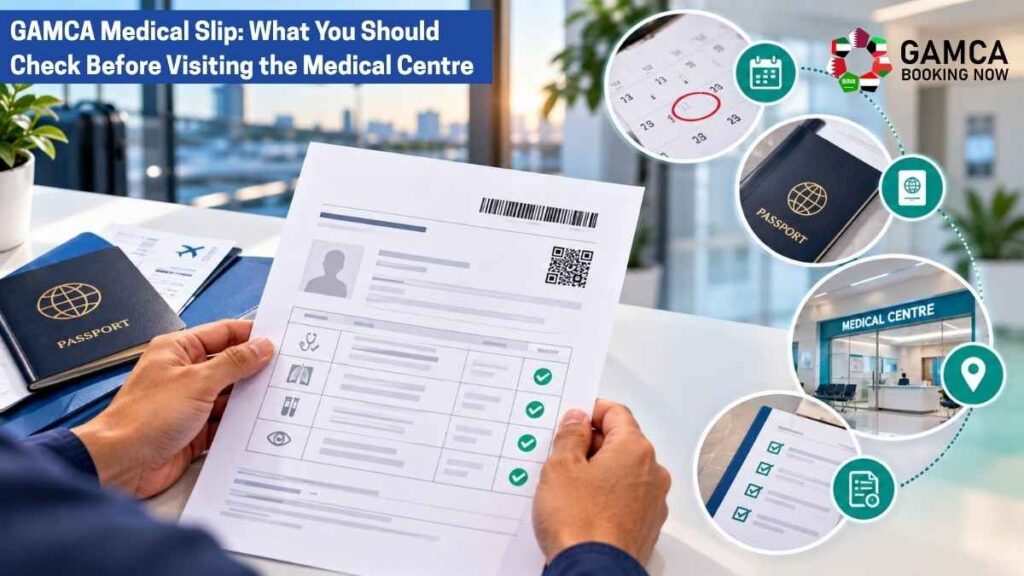
Quick Summary: What Must You Verify On Your Medical Slip?
Before testing day, cross-check your legal passport number, full name spelling, date of birth, target Gulf nation, and assigned center address. Any mismatch between your slip and passport stops clinic intake immediately. Catching clerical discrepancies early preserves your registration fee and avoids administrative disqualification at the reception counter.
A long journey from your hometown to a distant screening city brings hope, ambition, and heavy family sacrifices. You finally stand outside the clinic with your original travel documents, ready for your physical examination. The front intake officer scans your paper voucher, pauses, and turns you away because your slip spells your middle name wrong. Securing a genuine GAMCA Medical Appointment represents a major career investment, and even minor paperwork errors can halt your entire overseas job process without warning.
Official migration documentation records from early 2026 reveal that clerical mismatches cause nearly 18 percent of first-visit clinical rejections across South Asian testing hubs. A single misprinted digit in a passport series leaves clinical software unable to validate the central biometric file. The computerized Gulf Health Council registry demands complete harmony across every record before staff can draw blood or take a chest radiograph. When candidates travel across state borders without checking these key details, they risk losing both their travel expenses and precious appointment windows.
Understanding the administrative rules behind your documentation saves time, energy, and money. When you initiate your Book Your GAMCA Medical Appointment registration, the central Gulf portal locks your profile to a specific diagnostic center. The facility cannot change your core identity details once intake begins. Reviewing your confirmation document carefully helps ensure your health clearance proceeds smoothly from the start.
The Pre-Visit Audit: Old Paper Vouchers Versus Modern Electronic Slips
Understanding how digital verification replaced older manual forms explains why modern clinics enforce strict intake rules.
Verification Element | Legacy Manual Slip System | Modern WAFID Digital Slip | Practical Impact On The Candidate |
|---|---|---|---|
Identity Authentication | Manual visual inspection of printed names | Algorithmic barcode scan linked to national passport databases | Discrepancies halt intake immediately at reception |
Center Reassignment | Possible through local clinic staff intervention | Strictly locked by the central system allocation algorithm | Prevents unauthorized clinic switching on test day |
Clerical Correction | Manual pen corrections signed by clinic officers | Central electronic support ticket and voucher re-issuance | Requires formal digital data amendment before testing |
Slip Expiry Tracking | Flexible manual interpretation at the desk | Automated 30-day cutoff date enforced by software | Expired slips cancel testing eligibility automatically |
Test Record Matching | Paper laboratory forms stapled to passport copies | Biometric facial and fingerprint linkage to digital file | Eliminates document substitution and fraud entirely |
Why Gulf Immigration Systems Enforce Absolute Data Precision
Gulf state migration departments handle hundreds of thousands of work visa files every single month. Embassies in New Delhi, Dhaka, Colombo, and Manila rely on automated digital validation to clear incoming expatriates. If your digital health clearance shows an incorrect passport number, consular systems can’t link your laboratory results to your work visa file. This mismatch halts visa processing entirely, leaving workers stranded in costly bureaucratic limbo.
Modern medical screening relies on unified digital identity. When a candidate attends a registered GAMCA Medical Center, lab technicians confirm the voucher barcode against the central Gulf database. If the electronic file shows a clerical mismatch, the system blocks the test order. These safeguards prevent identity substitution and keep immigration records accurate across the Arabian Gulf.
This automated rigor protects both employers and job seekers. A verified registration ensures your final fitness certificate matches your legal travel credentials. Knowing what to do if your GAMCA slip details are wrong helps you fix mistakes before you board a bus or train to the clinic.
The Essential Five-Point Document Audit
Take twenty minutes at your kitchen table to verify these key fields before your travel date:
- Passport Number Concordance: Confirm that the numbers and letters match your physical passport booklet, and check zeros against the letter O.
- Legal Name Sequencing: Ensure your given name and surname match your passport lines, rather than personal nicknames.
- Destination Country Validation: Check that your slip names your exact destination, such as Saudi Arabia, Kuwait, Oman, Bahrain, or the UAE.
- Designated Medical Facility: Note the exact street address of your assigned center so you don’t visit an unauthorized local doctor.
- Voucher Validity Period: Verify that your test date falls comfortably within the printed thirty-day administrative validity period.
Catching errors early keeps your application moving forward. Review these fields right away to protect your schedule and keep your relocation plans on track.
Step-by-Step: Managing Your Screening Journey Smoothly
Following a clear, orderly plan helps your testing day go as smoothly as possible:
Conduct an Immediate Post-Booking Examination
Download your digital PDF slip as soon as registration finishes, then print two crisp physical copies.
Practitioner Insight: We recommend reading the printed slip aloud character by character against your passport page to catch subtle typos that look fine on a phone screen.
Verify Center Location and Operating Timings
Locate the approved clinic on a digital map and verify morning intake schedules before booking travel tickets.
Practitioner Insight: Most accredited centers stop morning blood draws by eleven o’clock, so plan to arrive by eight.
Resolve Clerical Discrepancies In Advance
If you spot an error, address it through official channels before visiting the diagnostic clinic.
Practitioner Insight: Never let an unauthorized local sub-agent use white correction fluid or ink pens on your printed slip, as security staff will reject altered paper immediately.
Prepare Personal Physical Readiness
Drink ample water, get plenty of rest, and avoid heavy salt or sugar intake for two days before your visit.
Practitioner Insight: Mild dehydration can elevate kidney parameters on your blood panel, prompting unnecessary and costly secondary tests.
Real-World Scenarios: How Careful Verification Protects Candidates
The Transposed Visa Profession
A carpenter from Indonesia secured a construction placement in Dammam and booked his health appointment. His agency clerk accidentally selected “Domestic Driver” instead of “Building Carpenter” in the profession field. The applicant noticed the discrepancy while reviewing his printed slip on the bus ride home.
He knew that clinical laboratory requirements vary by trade category, with food handlers and drivers facing different diagnostic protocols. Rather than traveling to the clinic with an inaccurate voucher, he used the proper channels to correct errors in your GAMCA slip or medical report online. The administrative desk updated his profession code within forty-eight hours, allowing him to complete his medical exam without delay.
The Expired Validity Window
A welder from Mali received his medical slip but caught seasonal viral flu two days later. He delayed his screening visit until he recovered, not realizing that his voucher was nearing its thirty-day limit. When he finally felt better, he checked his paperwork and saw that the validity date ended the next morning.
Knowing clinical computers automatically reject expired slips, he traveled to the assigned diagnostic center that same night. He presented his slip at the intake desk early the next morning while it was still valid. His quick action saved him from paying a full second registration fee.
What Actually Causes Clinical Disqualification On Test Day
Understanding common clinic issues helps you prepare for a successful visit:
- Active Elevated Blood Pressure: Stress and rushing to the clinic can spike your blood pressure, leading technicians to place your file on temporary hold.
- Unresolved Document Discrepancies: Mismatches between your birth date and passport details stop the computer registration process right away.
- Secondary Chest Shadows: Old, healed bronchitis scars can trigger mandatory sputum cultures and repeat digital radiographs.
- Fasting Blood Glucose Surges: Skipping hydration or eating heavy midnight sweets can push your morning blood sugar past standard thresholds.
- Missing Identification Photos: Arriving without white-background passport photos can disrupt your intake flow and delay testing.
Arriving with clear paperwork and good physical preparation prevents these common snags. Give yourself plenty of time to rest and review your documents before appointment day.
Frequently Asked Questions
No, the central computerized system allocates authorized facilities automatically to ensure fair, independent health evaluations. Individual clinics cannot transfer your digital file to another provider. If you cannot reach your assigned facility, you must wait for the voucher to expire after thirty days before booking a new clinic.
You must request an official data amendment through the booking portal before your clinic visit. Clinic receptionists cannot edit core demographic fields at their service counters. Attending an appointment with mismatched birth data will halt your evaluation and void your visit.
A standard registration voucher remains active for thirty calendar days from the date of issue. If you do not visit your designated facility within this window, the slip expires in the central database. Once expired, you must restart registration and submit a fresh payment.
While full overnight fasting isn’t strictly required in every Gulf nation, an eight-hour light fast helps keep your blood glucose and lipid readings steady. Drink plenty of plain water to stay well hydrated for your blood panel and urine test.
Bring your original passport with at least six months of remaining validity, your printed appointment voucher, and four recent passport-size photos with a white background. It is also wise to carry your national identity card and any prior immunization records.
Take The Next Step With Complete Peace Of Mind
Pursuing career opportunities in the Gulf is a proud milestone built on hard work and ambition. Protect your investment by verifying your documents carefully before you step out the front door. Reviewing every name, date, and identification number helps keep your administrative paperwork running as smoothly as your health checks.
Confirm your travel details, double-check your voucher, and book your GAMCA Medical Appointment with complete confidence. When your documents are accurate and ready, your overseas career can begin on solid ground.